
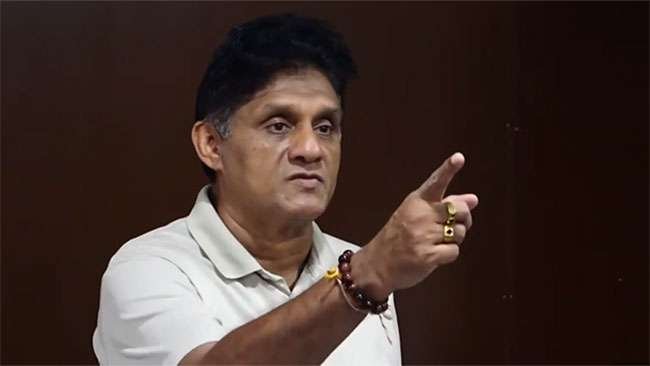
Sri Lanka faces risk of financial instability without new IMF agreement – Sajith
The Leader of the Opposition, Sajith Premadasa has warned that Sri Lanka could face a renewed risk of bankruptcy and called on the present government to immediately pursue a successor agreement with the International Monetary Fund (IMF), cautioning against what he described as “arrogance” in economic decision-making.
Addressing a meeting held at the Samagi Jana Balawegaya (SJB) headquarters to initiate discussions on forming the party’s teachers’ union, Opposition Leader Premadasa said that despite government claims that the country’s economic situation is stable, available data suggests otherwise.
He noted that while the President has stated that Sri Lanka’s foreign reserves stand at around US$7 billion, a portion of these reserves includes Chinese yuan holdings that are not freely usable, implying that the effective reserve position is lower than stated. He further stressed that international benchmarks require reserves sufficient to cover at least three months of imports—an indicator Sri Lanka is currently unable to meet.
With the country’s monthly import expenditure estimated at around US$2 billion, he said existing reserves fall short of the minimum threshold required for external stability.
Premadasa also warned that global developments, including ongoing tensions in the Middle East, could negatively affect Sri Lanka’s economy. He pointed out that although foreign remittances have risen to around US$8 billion, any escalation in conflict could threaten migrant employment and reduce inflows.
He added that countries such as India, which supported Sri Lanka during the COVID-19 pandemic and the 2022 economic crisis, may now have limited capacity to extend further assistance due to their own economic priorities. Premadasa also contrasted Sri Lanka’s public communication approach with India, stating that Indian leadership has been more transparent in informing citizens about economic conditions.
Referring to fuel prices, he noted that petrol, which reached around Rs. 470 during the 2022 crisis, is now approximately Rs. 410, urging the general public to understand such figures within the broader economic context.
The Opposition Leader further stated that Sri Lanka’s current IMF programme is expected to conclude in March 2027, warning that its expiry could affect the country’s credit ratings and overall financial stability. He said that foreign debt repayment obligations are projected to rise significantly by 2028, increasing pressure on foreign exchange reserves alongside import costs.
He emphasized the need for a successor IMF agreement, arguing that without adequate foreign currency inflows from exports and remittances, the country could again face a balance of payments crisis, particularly if global oil prices rise.
Premadasa urged the government to adopt what he described as a “people-centred IMF programme” and to ensure transparency in communicating economic realities to the public. He also criticized the administration for not convening an international donor conference during earlier economic difficulties, despite calls for such action.
The Opposition Leader concluded by urging authorities to move forward with a successor IMF arrangement without delay and to prioritize economic stability over political considerations.
Local News
Sri Lanka CERT warns of foreign university scams on social media
09 October 2026
Private sector to join Metro Bus Service within a year: Minister
09 October 2026
Red alert for severe lightning issued in 17 districts
07 October 2026
Trending News
SIMs to be deactivated on unregistered new mobile devices from tomorrow
30 September 2020
CSE ASPI touch all-time high of 10,037.61
27 October 2021
Popular actress Sureni Senarath passes away
26 May 2021