
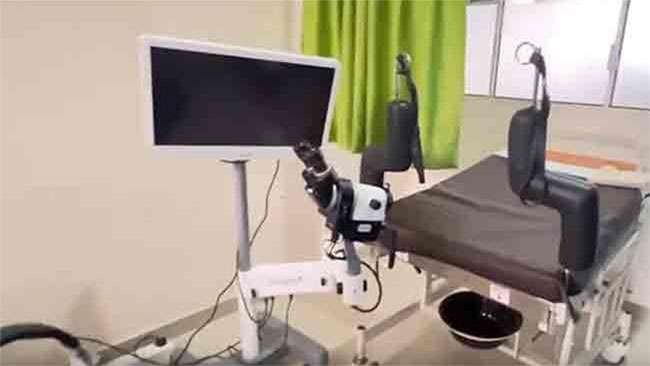
Health Ministry deploys new Colposcopy units to strengthen women’s cancer care
A total of 12 state-of-the-art colposcopy machines have been introduced to government hospitals to improve the detection and treatment of cervical cancer, which ranks as the fifth most common cancer among women in Sri Lanka, according to the Ministry of Health.
The Health Ministry stated that a further six machines are scheduled to be installed within the coming month, further expanding diagnostic capacity across the island.
Each colposcopy unit is valued at Rs. 6 million, with over Rs. 72 million allocated by the Ministry of Health and Mass Media for the initial phase of the project. An additional allocation of more than Rs. 42 million has been set aside for the second phase.
According to the Ministry, the newly installed machines are already operational in major hospitals in Anuradhapura, Badulla, Batticaloa, Jaffna, Kurunegala, the De Soysa Maternity Hospital, Kandy, Gampaha, Matara, Monaragala, Puttalam and Hambantota.
The remaining six machines are expected to be installed in teaching and district general hospitals in Ampara, Ragama, Kalutara, Kuliyapitiya, Matale and Vavuniya.
Once fully implemented, the total number of colposcopy machines in the state health system will rise to 33, significantly strengthening island-wide screening and treatment services.
Health authorities said the expansion aims to ensure equitable access to cervical cancer screening and early diagnosis services across all regions of the country.
A colposcopy is a diagnostic medical procedure used to examine the cervix and vagina for abnormal tissue changes. The device provides magnified, detailed imaging that assists clinicians in identifying precancerous lesions and other abnormalities for timely treatment.
Specialists in obstetrics, gynecology, and gynecologic oncology use the equipment as part of cervical cancer screening and management programmes.
Meanwhile, the National Cancer Control Programme noted that cervical cancer is largely preventable when detected early, as it is commonly caused by the human papillomavirus (HPV). It remains a significant public health concern in Sri Lanka, with approximately 1,200 new cases diagnosed annually and around 180 deaths reported each year due to late detection or inadequate treatment.
Local News
Govt. to amend Ayurveda Act
20 October 2026
PUCSL approves one-hour power cuts for 3 days: Schedule released
19 October 2026
Trending News
SIMs to be deactivated on unregistered new mobile devices from tomorrow
30 September 2020
CSE ASPI touch all-time high of 10,037.61
27 October 2021
Popular actress Sureni Senarath passes away
26 May 2021